Quantifying global dimensions of resilience

Find out more about the different routes to entry and our eligibility criteria
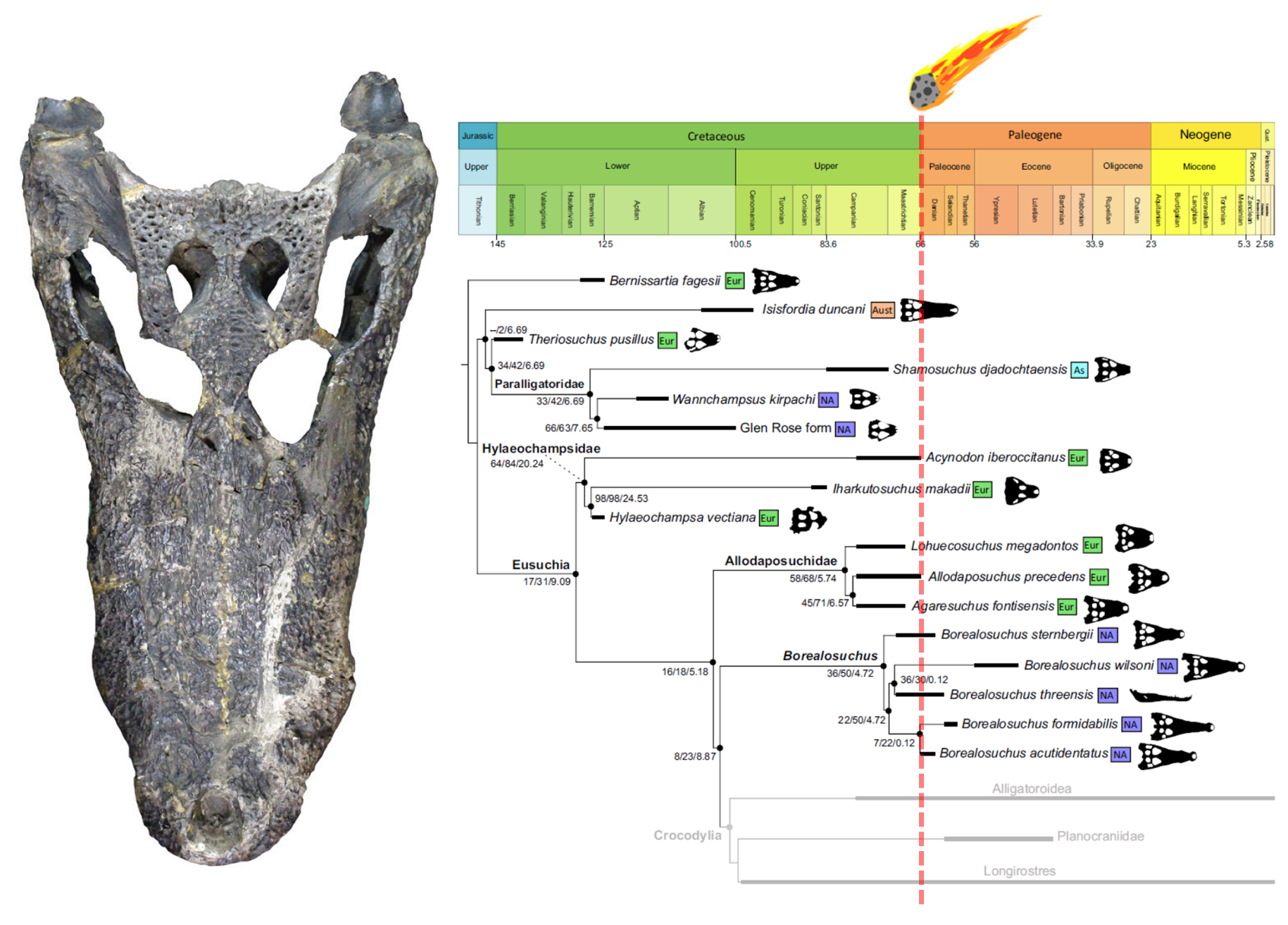
Living crocodylians (alligators, caimans, gavials, true crocodiles) are the remnants of a diverse radiation, first appearing 100 million years ago. However, our understanding of their initial diversification is obscured by uncertainty in reconstructions of their early evolutionary relationships. For example, a recent study suggested that the Cretaceous giant, Deinosuchus, and the Cenozoic hyper-diverse genus, Diplocynodon, long-thought to represent early alligatoroids, in fact lie outside of Crocodylia. However, existing trees do not sufficiently sample taxa unequivocally outside of Crocodylia to robustly test the position of enigmatic taxa. Such uncertainty also affects assessments of extinction selectivity across the end-Cretaceous mass extinction, i.e. which lineages survived and what factors differentiated them from the victims. Through first-hand study of specimens and the literature, the PhD student will produce an expanded phylogenetic dataset, improving sampling of early-diverging crocodylians and neosuchian crocodyliform species outside of this radiation. This dataset will be analysed to produce a new evolutionary tree that clarifies the relationships at the base of Crocodylia, including a more robust assessment of the placement of enigmatic taxa. The newly assembled tree will then be utilised to test for phylogenetic clustering of extinction and to determine whether ecomorphological and abiotic differences were key to survival versus extinction of crocodyliform lineages across the end-Cretaceous mass extinction. As part of this, the PhD student will test the hypothesis that traits associated with low survivorship at mass extinctions are not associated with higher extinction rates at other times, i.e. the ‘rules’ of extinction are not always the same.
The PhD candidate will receive training in vertebrate anatomy, virtual reconstruction of CT scan data, and phylogenetic and macroevolutionary analyses. They will also receive training in scientific writing, presentation, and open research practices. These will be delivered by one-to-one instruction by the supervisory team, including via feedback on draft manuscripts and conference talks. The PhD candidate will also be encouraged to attend existing palaeontological/macroevolutionary training workshops.
This project would prepare the PhD candidate for a career in academia, giving them the skillset and burgeoning independence to take the next steps via a postdoctoral position. It will also provide them with numerous transferrable skills, such as project management, quantitative data analysis, and presentation of results, that will serve them well in other professional, non-academic sectors.
The project will require study of fossil specimens accessioned in overseas museums. Travel could be reduced or, if required, avoided entirely by a combination of utilising the published literature and available online datasets, coupled with requesting photographs and scan data from museum curators and colleagues. Other options include shifting focus to greater use of and study of CT scan data, for which travel is usually not required, although additional funding might be need to cover the costs of CT-scanning time at international institutions.